
Research Projects
Displaying 21 - 30 of 263
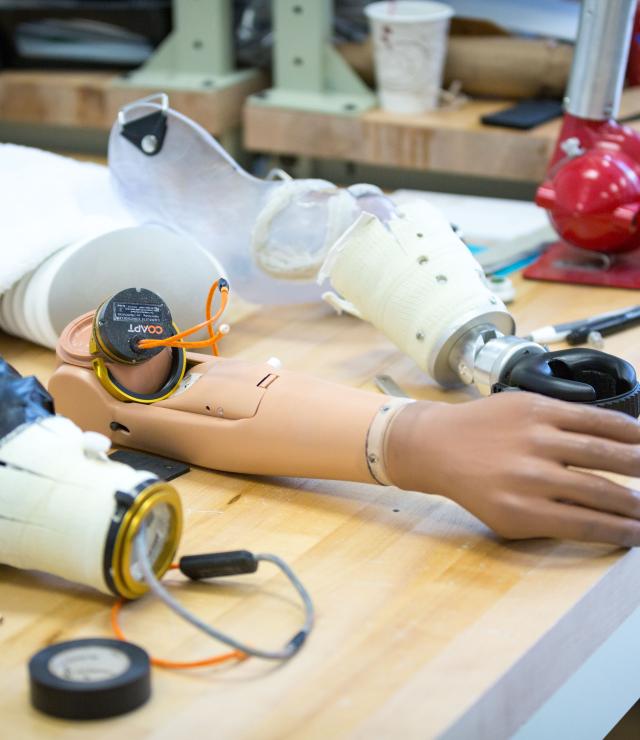
Virtual Reality Outcomes Testing for Upper Limb Prosthesis
The goal of this study is to compare clinical performance measures in an immersive virtual reality (VR) environment to performance with a physical upper limb prosthesis.
Research Project

Acute Intermittent Hypoxia and Neuroplasticity in MS
Intermittent Hypoxia Initiated Motor Plasticity in Individuals with MS
Research Project

Enhancing Accessible and Inclusive Airline Travel for People with Physical Disabilities
The goal of this proposal, developed by an interdisciplinary team led by Shu Cole, PhD, professor of health and wellness design at Indiana University, is to conduct research to generate new knowledge that can be used to improve the airline travel experiences of people with disabilities, including those with the greatest support needs.
Research Project

Visual Feedback of Kinematic Chain in a Redundant Novel Task
This study utilizes a wearable data glove system that translates hand movements into signals that control a cursor on a screen. We examined how participants learn a redundant novel task, which can be completed through various solutions.
Research Project

Developing probability distribution models from upper extremity free exploration trials to evaluate motor deficits in stroke patients
Stroke survivors vary greatly in their motor deficits and rehabilitative needs. Here, we gather unstructured upper limb movement data and seek to understand if there are patterns in their kinetics that reflect the underlying neuromuscular alterations. In doing so, we can improve our abilities to evaluate patients and design personalized rehab therapy.
Research Project

Altering Post-Stroke Motor Recovery
True behavioral restitution, a return to normal motor patterns with the affected limb post-stroke, requires the recruitment and restoration of the residual ipsilesional hemisphere/corticospinal tract (CST). Following stroke, the spontaneous recovery mechanism selectively and continuously uses a more optimized neural network for motor execution, depending on the degree of CST damage.
Research Project
Identification of sensory-motor control in reaching
Sensory inputs such as vision, proprioception, and touch play a crucial role in post-stroke recovery. Our research delves into how these sensory contributions can be assessed to develop effective, personalized therapy strategies. Enhancing and tailoring sensory inputs to an individual’s needs allows us to explore how learning outcomes can be improved and errors reduced. Through synthetic simulations that combine muscular, visual, and proprioceptive inputs, we aim to understand better the complex processes involved in motor learning.
Research Project
Eglove
Body Computer Interface (BCI) is the idea that one can control a robot simply by thinking about it. In this study, we are laying the groundwork for further BCI and robotic development for individuals to control a hand opening device called the Electro encephalographic mediated glove (or Eglove) using an EEG cap connected to a motorized glove.
Research Project
Forearm ExoNET
Can you build a soft, exo-robot as a wearable orthosis to provide assistance during both rehabilitation and activities of daily living? Can this same device also be used as a therapeutic device by tuning to anti-assistance mode, providing more meaningful therapy to the user?
Research Project
ExoNET for Gait
Is it possible to use a network of springs to make up for what the muscles do during walking and hence assist gait? This study shows the potential of the ExoNET device to reproduce the torques generated by your muscles while you walk. We feel that this structural design can guide devices in the future and may lead to clinical tools that are lightweight, unintimidating, easy to use, and inexpensive.
Research Project