
Body
To help clinicians, researchers and healthcare leaders stay informed about emerging evidence, Shirley Ryan AbilityLab publishes In a Nutshell, a monthly journal review series written by our expert scientists and clinicians. This month's edition, authored by Allen Heinemann, PhD, director of the Center for Rehabilitation Outcomes Research (CROR), examines how inpatient rehabilitation facilities are increasingly evaluated based on patient outcomes — and asks a fundamental question: Are we measuring what really matters?
Value-based Rehabilitation Requires the Right Ruler
What’s the big deal?
Inpatient rehabilitation facilities are increasingly evaluated—and paid—based on patient outcomes rather than the amount of therapy provided. This focus incentivizes organizations to deliver the highest quality care in the most efficient way possible. As a result, it has become increasingly important to understand not just how much therapy patients need, but which interventions contribute most to functional improvement. The authors of this month’s Nutshell explored that question and, in doing so, raised an even bigger one: Are we measuring what really matters?
What did they find?
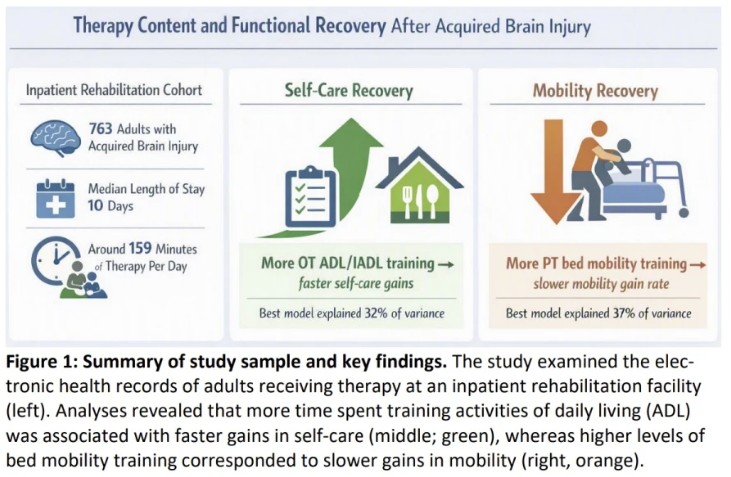
The study team analyzed electronic health record and billing data from 763 adults with acquired brain injury treated at an inpatient rehabilitation facility between 2012-2017. Patients stayed a median of 10 days and participated in an average of 159 minutes of therapy per day. Researchers examined whether specific therapy activities were associated with improvements in scores on the Self-Care and Mobility sections of the Functional Independence Measure (FIM), a standardized measure widely used by insurance companies to assess functional outcomes. The therapy factors measured in the study accounted for 32% of improvement in self-care and 37% of improvement in mobility. This finding suggests that much of patients' recovery was influenced by factors beyond therapy activities, including their diagnosis, level of impairment, and other individual characteristics. They found that increased occupational therapy training on activities of daily living (ADLs) was associated with faster gains in Self-Care scores. In contrast, greater time spent on bed mobility training (e.g., rolling, transitioning from lying to sitting) during physical therapy was associated with slower gains in Mobility scores (Fig. 1). However, the authors do not interpret this finding as evidence that bed mobility training is ineffective. Rather, they suggest that it reflects a limitation of the outcome measure and name this as a challenge of value-based payment models. While some aspects of therapy, like bed mobility training, may be clinically necessary, they do not necessarily yield functional gains that are detected by commonly used outcome measures.
How does this affect how I treat patients?
The findings highlight an important caution: outcome measures must align with clinical goals to fully capture the value of rehabilitation interventions. Important clinical gains are not always reflected in the metrics used to determine payment. Thus, clinicians and payers should consider both standardized measures and patient-centered goals when defining treatment success. Otherwise, interventions that support meaningful recovery may appear less valuable simply because their benefits are not captured by the measures being used.
Reference: Cogan, A. M., Roberts, P., Mallinson, T. (2024). Association of rate of functional recovery with therapy time and content among adults with acquired brain injuries in inpatient rehabilitation. Archives of Rehabilitation Research and Clinical Translation, 6: 10.1016/j.arrct.2024.100370.