Body
At 17, Natalie S. was all momentum — an athlete and recent high school graduate with a spot on a Big Ten cheerleading squad. But, just weeks into summer, doctors discovered a cerebral arteriovenous malformation (AVM) — a tangled mass of blood vessels — deep in her brain.
Although she had no symptoms, the AVM could rupture at any time. Instead of cheering for her school’s football team that fall, Natalie began treatments to shrink the AVM.
Seven years later, Natalie was living in Chicago when her neurosurgeon determined that the AVM was small enough to remove. Though he anticipated a straightforward operation, Natalie experienced serious complications.
After 13 hours in surgery, Natalie woke with paralysis on her left side and had lost half of her visual field in both eyes. From the middle of each eye to the left, everything was black. After three weeks in acute care, Natalie transferred to Shirley Ryan AbilityLab for inpatient rehabilitation, where she received a stroke diagnosis. Though she made progress, she felt lonely and discouraged. Against medical advice, Natalie ended her stay early and returned home to Springfield, Ill., to be near family.
The Long Road Back After Stroke
Body
In Springfield, Natalie continued rehabilitation, regaining some mobility and the ability to walk, but other complications proved harder to manage. She developed seizures and severe spasticity — painful, involuntary muscle spasms that curled her fingers and toes, limited her hand dexterity and affected her gait.
“I felt like everything had been taken from me,” said Natalie. “I lost my job, my apartment and my sense of self.”
Longing for the life she’d had before the stroke, she moved back to Chicago and pursued new spasticity treatments at Shirley Ryan AbilityLab. She received medical care, outpatient therapy and botulinum toxin (botox) injections to manage her spasticity. The treatment relaxed her stiff muscles and improved her range of motion, enabling her to move more freely.
Gradually, Natalie rebuilt her independence. She learned to navigate public transportation, found accessible housing and even landed her dream job.
With support from an organization that provides career assistance for people with impairments, Natalie secured an account manager position at a major Chicago advertising agency. On paper, her education and talents made her a perfect fit. In reality, she had not given herself enough time to heal before joining such a demanding workplace.
“I didn’t set myself up for success,” she said. “It’s hard for anyone to start a new job, but when you have a limp, you’re typing one-handed and people are staring at you, it’s rough.”
Socially, she struggled, too. Outings with friends became a reminder of everything she had lost. Her girlfriends wore dresses and heels; Natalie wore a bulky ankle-foot orthosis and an oversized shoe to accommodate it.
The gym and the dance floor were once places where she felt powerful and free. Now, the strength, coordination and freedom of movement she took for granted were gone.
For many years, Natalie battled depression. At the time, there were no support groups for younger stroke survivors. She had no one to confide in about the shame of trying to hide her impairments or the grief of losing control over her body.
Her healing began when she started taking anti-depressant medication and working with a psychologist.
Natalie had long been her own toughest critic.
She regretted decisions she made during recovery — especially leaving rehabilitation early — but slowly learned to forgive herself. She found strength in a personal motto: “I did the best I could, given the circumstances I was in.”
Paying It Forward as a Peer Mentor
Body
As she grew stronger emotionally, Natalie began volunteering at Shirley Ryan AbilityLab, where she discovered a new purpose: helping others navigate recovery as a peer mentor. The Henry B. Betts, MD, LIFE Center peer mentor program connects patients and families with mentors who share similar conditions and have successfully transitioned back into the community.
“It took me 15 years to overcome debilitating depression and rebuild my life on new terms,” said Natalie. “I love seeing patients’ eyes light up when they realize that I was in the same place they are now, and they see everything I’ve accomplished. By sharing my story, they see that they can do it, too.”
Natalie encourages mentees to develop their own recovery mottos, lean on their support systems and set realistic goals. She stresses that recovery is an ongoing process. Twenty years after her stroke, she’s still navigating, sometimes stumbling and always growing.
“The peer mentor program gives patients a concrete example of someone who has survived a major illness or injury and returned to the world. I love sharing the lessons and discoveries that took me years to find,” she said. She recently discovered a new passion that has transformed her own recovery — adaptive sports. Through adaptive cycling and rock climbing, Natalie reconnected with her athleticism and grew stronger physically and mentally.
“I get so excited telling my mentees about adaptive climbing,” she said. “Everybody’s cheering for you. And, no one asks about your disability.”
Being a peer mentor and an athlete again helps Natalie feel like she’s truly living life, not just managing it. She offers proof that life after stroke can be meaningful and joyful, and that quality of life can be redefined.
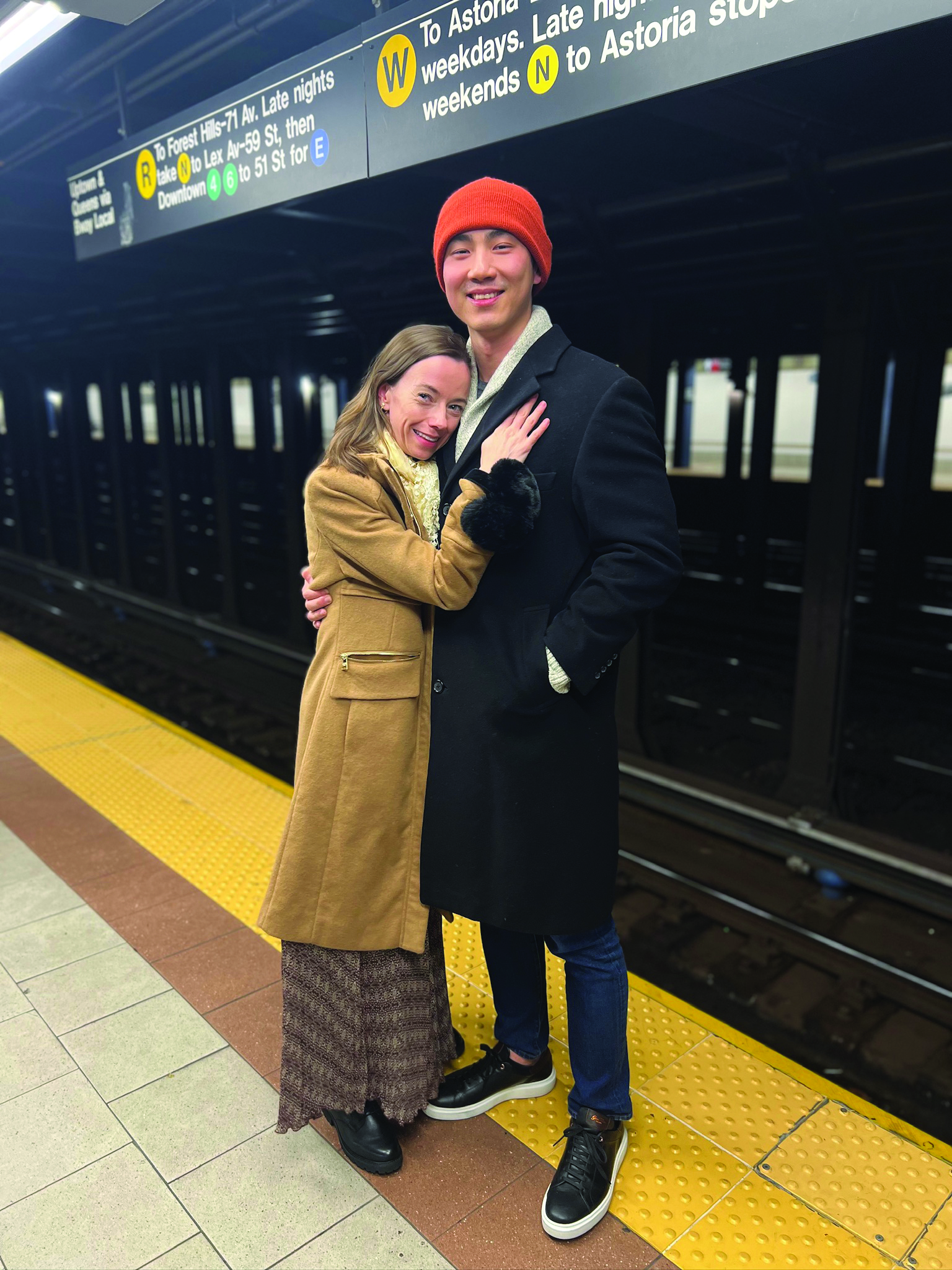
Today, Natalie lives in New York City with her husband, Will. They enjoy exploring the city, traveling and discovering new adaptive climbing opportunities. As she now mostly mentors virtually, Natalie remains deeply committed to helping others find hope.