Body
Parkinson’s disease (PD) is a progressive brain disorder that primarily affects movement — often causing tremors, rigidity and bradykinesia (slowness with movement). These movement changes can also show up in everyday tasks like handwriting, due to symptoms such as shaking or hand tremors; stiff or slow hand movements; or “micrographia,” a change in which your letters become smaller, and your words crowd together when writing.
If handwriting has become more difficult while living with PD or another condition — whether you’re filling out medical documents or jotting yourself a note — you’re not alone. These five simple tips can make writing easier and more comfortable.
1. Set yourself up for success
Body
Make sure you are sitting in a supportive chair near good lighting and use a tabletop surface for writing. Try to sit up tall with your writing arm on the tabletop to support your elbow and wrist. Focus on the writing task by limiting any distractions such as music or TV.
Use lined or graph paper. This provides your brain with a visual aid to help guide the size and spacing of your letters.
2. Try to hold the pen in a different position.
Body
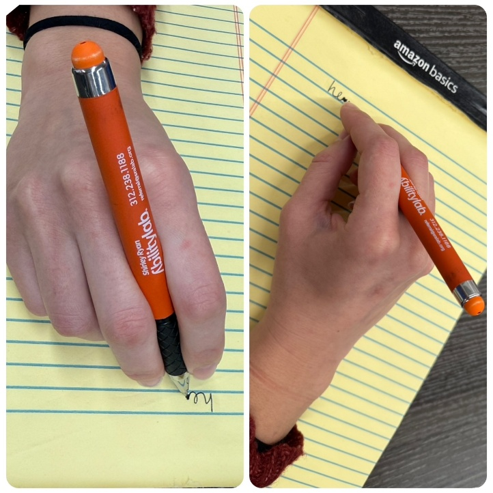
Sometimes, all you need is a little bit more support in using your writing utensil! Try positioning the pen between your index and middle finger, with your thumb helping to hold at the tip, to allow for more stability. Slightly changing the position you use to hold the pen can make all the difference.
3. Try using a different writing tool.
Body
Have you tried a different type of writing utensil? There are a few things you can change, including the size of the pen, the ink style, the grip and the weight.
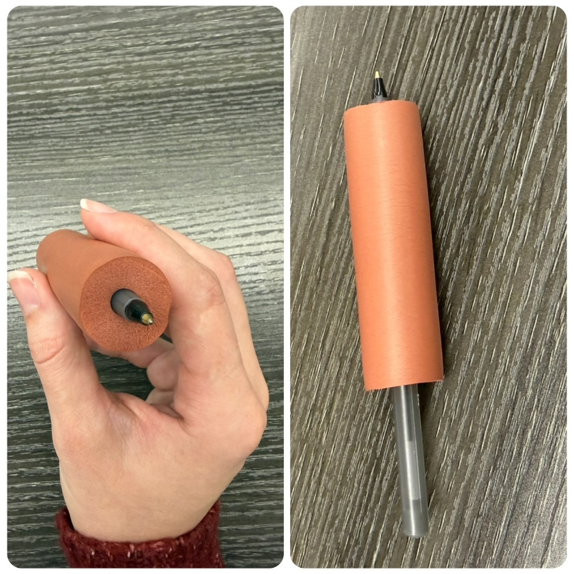
Sometimes, just increasing the size of the pen can make a huge difference in your control and comfort with the utensil. As an occupational therapist, I commonly recommend applying foam tubing or wrapping self-adhesive elastic wrap around the pen to make it larger. Or, by applying a rubber grip, you can ease the pressure needed to stabilize the pen at your fingertips.
Another idea is to try a gel-ink pen. Gel ink requires less effort to draw on the paper, which may help with the ease of writing as well as ink visibility.
Finally, if you are experiencing tremors, utilizing a weighted pen may help to minimize involuntary pen movements and could improve line quality (in which pen strokes are smooth, steady and continuous).
4. Think BIG and SLOW.
Body
If your letter size is getting smaller as you write, make sure to think about big letters in your head. By telling your brain to write “bigger” than it needs to, your brain can send a “larger” signal to the muscles of your hand, helping to increase the letter size being created. For example, try to imagine you are writing on a chalk board or white board instead of on a sheet of paper.
And, do not rush! Always make sure to write slowly and allow yourself plenty of time. Intermittent rest breaks may be needed to help keep the letter size large as you write.
5. Write in print lettering instead of cursive.
Body
Printing creates more separation between letters, which can help with the clarity of each letter being written. This also allows you to lift the pen between letters, giving you brief opportunities to rest and reset your hand. Printing uses simpler, more distinct movements that may be easier to manage.
When to Make an Appointment
Body
These changes may feel awkward or odd at first, and that’s okay! Your handwriting style has been ingrained in you since you were a child, so it could take some time to feel comfortable with these new modifications. Give yourself some time to try a strategy or two and see what helps.
If you still are having difficulty, speak to your primary care physician or neurologist about being evaluated by an outpatient occupational therapist. In occupational therapy, you will have an opportunity to practice with different writing utensils and gain strategies to maintain or improve your handwriting skills.
Meet Our Expert
Body
Anne Picchiotti, OTR/L, is an occupational therapist at Shirley Ryan Ability Lab’s Northbrook Outpatient Center. Anne has been practicing in outpatient therapy for approximately five years, treating adults with a variety of diagnoses. She has a passion for working with patients with neurological conditions such as Parkinson’s disease, stroke and brain injuries. When she is not working, Anne enjoys spending her time engaging in fine motor hobbies like crochet and embroidery.