Body
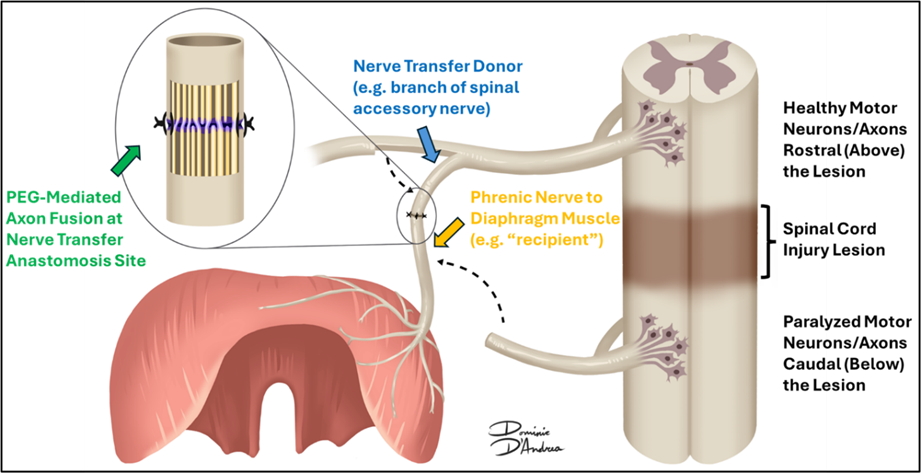
Colin K. Franz, MD, PhD, has been awarded a Falk Medical Research Trust Catalyst Award to support a new translational research project focused on restoring diaphragm function after high cervical spinal cord injury. The project, titled Accelerating Diaphragm Reinnervation After Spinal Accessory to Phrenic Nerve Transfer Using Human Axon Fusion Technology, addresses a major unmet need in neurorehabilitation and respiratory care.
High cervical spinal cord injury frequently results in permanent diaphragm paralysis, leaving individuals dependent on invasive mechanical ventilation with no proven therapies to restore natural breathing. Although nerve transfer surgery offers a potential path to recovery, functional outcomes are limited by the slow and often incomplete process of axonal regeneration.
This project aims to overcome that barrier by integrating a novel axon fusion technology, NTX-001 (PEG fusion), into spinal accessory to phrenic nerve transfer procedures. Unlike conventional nerve repair, which relies on donor axons regenerating over months to years, PEG fusion directly reconnects severed axons within minutes, preserving the distal nerve environment and enabling rapid reinnervation.
The study will pursue two specific aims: first, to determine the functional benefits of PEG fusion assisted nerve transfer in a preclinical model, and second, to assess long term respiratory and electrophysiological outcomes. Diaphragm recovery will be evaluated using neuromuscular ultrasound, electromyography, transdiaphragmatic pressure testing, and neuromuscular junction analysis.
The project is led by Dr. Franz at Shirley Ryan AbilityLab, with Sumanas Jordan, MD, of the Northwestern University Department of Surgery, serving as co investigator. Kevin Swong, MD, of Northwestern University Neurosurgery, is serving as a surgical consultant as the team plans future first in human clinical trials at Northwestern and Shirley Ryan AbilityLab.
Supported by a partnership with Neuraptive Therapeutics and leveraging NTX-001’s FDA Fast Track designation, this high-risk, high-reward project has the potential to establish a new paradigm for early diaphragm reinnervation and ventilator liberation, while laying essential groundwork for clinical translation in individuals with cervical spinal cord injury.